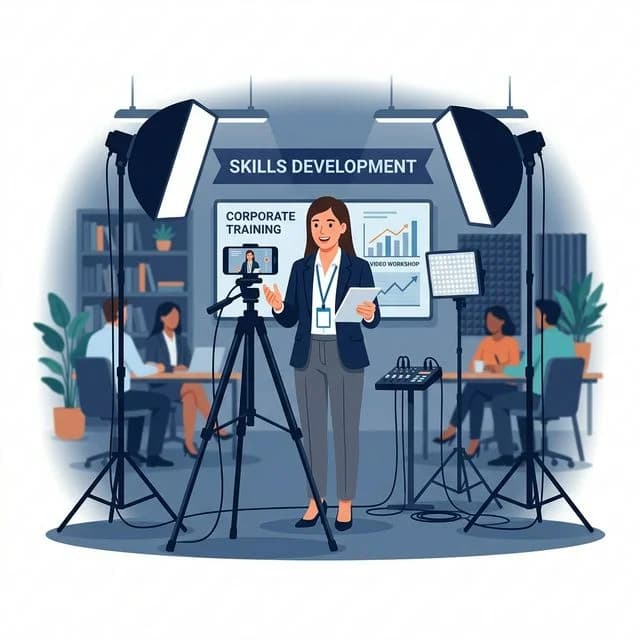
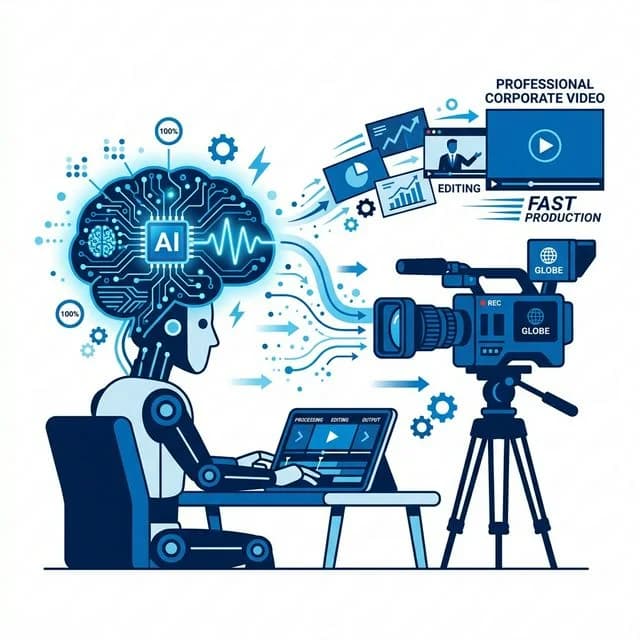
How Is Artificial Intelligence Revolutionizing Corporate Film Production?
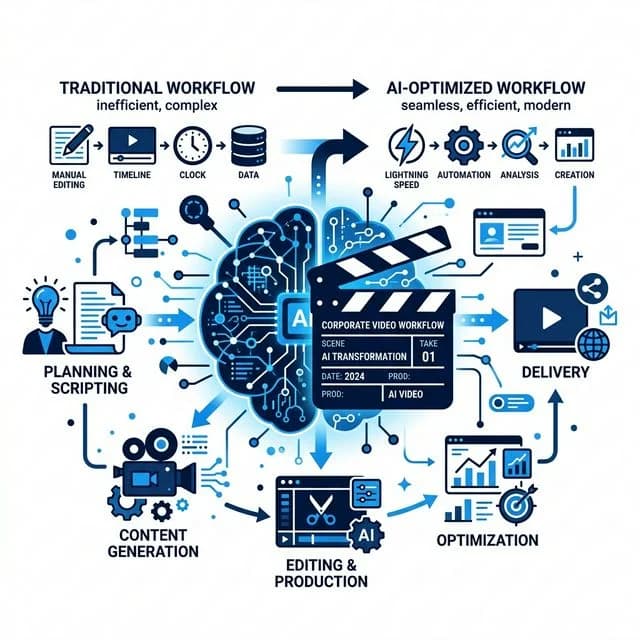
How Is Artificial Intelligence Revolutionizing Corporate Film Production?
Artificial intelligence (AI) is penetrating the corporate film production sector not as a mere technological novelty, but as a critical instrument that collapses production timelines, slashes capital requirements, and spikes message efficacy. For massive firms and global corporations investing in high-end video, AI unlocks unprecedented capabilities at every phase — from the initial script genesis to final asset distribution.
💡 Key Takeaways (TL;DR)
- A New Phase of Intel Analysis: Utilizing AI to audit market sentiment generates significantly more intentional and precise voiceover scripts.
- Lightning-Fast Translations and Flawless Editing: AI algorithms can identify specific B-roll takes, collapsing search time from hours to seconds and accelerating the rough-cut phase.
- Storyboard Visualization: Before a single camera is deployed to the set, we can simulate the final visual impact with high fidelity, granting the client absolute psychological control over the finished frame.
1. Analysis of Market Data and Communication Trends
AI can audit corporate communication trends, audience preferences, and the historical efficacy of similar video campaigns in real-time. For Marketing Directors in massive enterprises, this translates to the power of making production decisions based on hard data rather than intuition. A film script engineered on market analysis has a fundamentally higher potential for success.
2. Generating Concepts and Preliminary Scripts
Generative AI algorithms empower content creators during the critical conceptual phase. Based on a client's brief, industry vertical, and target demographic, AI can propose themes, narrative arcs, and dramatic structures. This does not replace a veteran scriptwriter — it weaponizes the creative process with fresh perspectives and accelerates the pre-production timeline.
3. Mass Personalization of Content at Scale
One of the most consequential capabilities of AI in corporate film production is content personalization. AI systems can generate variations of a single film optimized for different markets, languages, and audience segments. A global entity — like those collaborating with Sema Studio — can simultaneously communicate with the German Board, UK partners, and Polish clients using the same core asset.
4. Augmenting Dialogue and Voiceover Creation
Natural Language Processing (NLP) algorithms empower the creation of authentic dialogues and voiceover scripts. By auditing a specific brand's communication DNA, AI helps maintain ironclad tonal consistency across the entire asset — in both Polish and English iterations.
5. Optimization of Narrative Architecture
AI identifies the exact coordinates in existing video assets where audiences lose focus and suggests tactical changes to the dramatic structure. For corporate films targeting platforms like LinkedIn or YouTube, where attention spans are surgically limited, this optimization has a direct impact on campaign ROI.
6. Sentiment Analysis and Tonal Precision
Advanced AI systems audit the emotional triggers within specific scenes and takes. This allows for the surgical tuning of the film's entire atmospheric mood to the desired effect — whether building unshakeable trust, inspiring a global workforce, or striking fear into the heart of the competition for prospective investors.
7. Automated Linguistic and Stylistic Auditing
At the script phase, AI eradicates linguistic errors, refines style, and verifies the consistency of specialized industry terminology. In dual-language Polish-English productions, this is an invaluable tool guaranteeing an elite level of transmission across both theaters.
8. Post-Deployment Performance Analysis
Following a film's launch, AI audits viewing data: retention rates, click-through metrics, and hard conversions. This intelligence is mission-critical for planning subsequent corporate productions and optimizing the master content marketing strategy.
9. Supporting Inter-Departmental Collaboration
AI-powered collaboration platforms streamline the friction between marketing divisions, executive boards, and the external production unit. All comments, script iterations, and final approvals are centralized into one digital hub — less email, more operational efficacy.
10. AI as a Creative Vanguard, Not a Replacement
It is mission-critical to understand that AI does not replace a combat-tested film crew. It weaponizes them. The fusion of AI technology with human creativity, psychological understanding, and years of experience producing for brands like Huawei or Discovery Channel — this is the standard Sema Studio delivers to its corporate clientele.
Case Study:
Mini Case Study: Hyper-Personalization for Executive Objectives: During a corporate film execution for a global logistics empire, we were ordered to prepare two distinct communication tones from a single base repository.
AI empowered the Rough Cut phase, automatically segregating 'clinical professional' scenes for shareholders from 'inspirational and human' shots for the recruitment division, while filtering participant vocabulary across the English-language interviews. **This tactical solution collapsed post-production capital requirements for the variation by nearly 50% compared to legacy manual editing.**
We optimized the process, yielding a measurable return on investment (ROI).
The integration of artificial intelligence into corporate film production is not a distant future — it is the current reality. Firms that are embedding AI into their production workflow today are capturing a lead that their competitors will be unable to overcome in the short term.
Frequently Asked Questions (FAQ)
Will the use of artificial intelligence make my film appear 'cheap' or synthetic?
Only if you attempt to use AI as a complete replacement for a production crew — e.g., using low-rent generic AI avatars. In the professional B2B sector, the baseline remains high-fidelity, broadcast-quality cinema footage of real humans. AI only engages as a 'turbocharger' during the editing or multi-language post-production phases. Quality is spiked without ever sacrificing authenticity.
What is the utility of AI-generated storyboards?
By simulating frames via high-end prompts (utilizing tools like Midjourney), the client gains 100% certainty regarding the color palette, lens selection, models, and set design long before we deploy tripods to a server room in Munich. This surgically removes the risk of expensive re-shoots after the primary production has concluded.