Sponsorship Billboard — Law, Rules, and Production for TV Stations
Sponsorship Billboard — Law, Rules, and Production for TV Stations
A sponsorship billboard is a highly specialized form of marketing communication in television, strictly regulated by media law. For large corporations that sponsor television broadcasts, knowledge of the rules governing this format is mandatory — from both a legal and production standpoint.
💡 Key Takeaways (TL;DR)
- Strict Rules of Engagement: A sponsorship billboard generally lacks the legal right to 'sell'; it must politely 'present' the sponsor. Legally prohibited are aggressive calls-to-action or promoting product utility.
- Fractions of a Second: The format forces an incredible directorial pace given the statutory lock of exactly eight seconds, into which a fast legal dialogue and logo placement are mandatory.
- The 'Sponsor' Mandate: This word, under KRRiT (National Broadcasting Council) regulations, often occupies a massive portion of the screen to maintain the statutory 1/4 requirement, preventing the video from being rejected.
What is a Sponsorship Billboard?
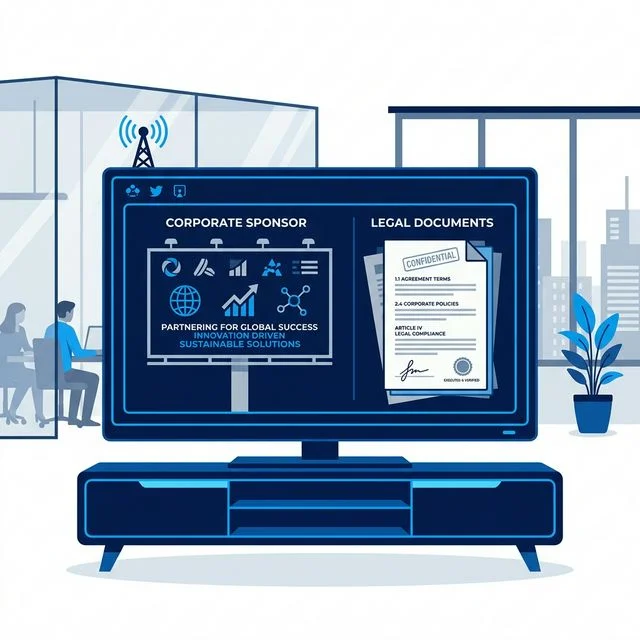
A sponsorship billboard (sponsor indication) is a short cinematic asset broadcast before or after a program sponsored by a given firm. Its narrative content can be schematically described by the sentence: "The sponsor of this program is — the manufacturer of product X." It is not an advertisement in the traditional sense — it is a form of brand visibility strictly defined by the laws governing radio and television broadcasting.
Critical Differences Between a Billboard and an Advertising Spot
Duration — A sponsorship billboard has a strictly defined broadcast time: 8, 16, or 24 seconds (depending on the number of sponsors listed). A standard advertising spot can be significantly longer.
Function — A billboard may exclusively identify the sponsor. It cannot promote sales, encourage the use of products, or utilize advertising slogans. It cannot support an idea or aim to achieve a direct advertising effect.
Content — In a billboard, one can mention the company name or product name, use a trademark, and briefly indicate the industry of operation. Prohibited are descriptions of product features, comparisons with competitors, and any calls to action.
Legal Requirements
TV broadcasting laws precisely dictate what is permissible in a sponsorship billboard:
The appearing word "sponsor" (in any grammatical form) or a legible text distinguishing itself from the background, occupying at least 1/4 of the screen surface — visible throughout the entire broadcast time — is mandatory.
The voiceover text must comply with regulations: within 8 seconds, a maximum of two sentences can be spoken. The copywriter for a sponsorship billboard operates within extremely narrow confines — message precision, not creativity, is the priority here.
The firm broadcasting the billboard must sign a sponsorship broadcast agreement for the program and submit a declaration that no fragments of an advertising message will be used in the creation of the billboard.
Trademarks in Sponsorship Billboards
A billboard may contain the sponsor's trademark in the form of a graphic symbol, word, phrase, or slogan. Condition: a verbal trademark can only appears if it lacks advertising traits. To verify trademark ownership, the client must present documentation from the Patent Office.
Case Study:
Mini Case Study: Success in a Prestigious Prime Time Slot: A recognizable FMCG corporation spent a significant pool on sponsoring a segment of the most expensive culinary program on a private free-to-air station.
We pivoted away from expensive filming with awkward actors who couldn't deliver the required dynamics within eight seconds. Instead, we produced a mesmerizing 3D macro fluid simulation of the product (liquid chocolate flowing over a biscuit), backed by a 7-second professional voiceover. The station didn't issue a single correction, and the broadcast launched immediately.
Brand recognition among national consumers skyrocketed, with Nielsen Audience reports showing increased profitability and reach reaching several million viewers during a single, uninterrupted segment.
Cost of Sponsorship Billboard Production
The production price for a sponsorship billboard varies and depends on the form (2D, 3D animation, live-action with an actor), technical depth, studio time, and post-production. Despite the format's apparent simplicity, the rigorous legal requirements and the necessity for surgical execution mean a billboard requires a professional approach. Contact Sema Studio to receive a quote tailored to your specific project.
Frequently Asked Questions (FAQ)
How do we know if our prepared sponsorship billboard will pass through the station's legal department?
At Sema Studio, we don't allow clients to gamble on a premiere. Before approving a final recording set, we send every frame-based storyboard for consultation with KRRiT and directly to the lawyers of the broadcaster for early 'approval' (kolaudacja).
Is it worth modifying the product on the same spot throughout the year?
Sponsorship 'packages' created in a full 3D graphical environment or via re-editing a master file make adding or swapping a different bottle later several times cheaper than filming from scratch. It only requires minor license fees for the artist, making the format extremely scalable over the years.