ESG Film and CSRD Reporting — How Video Turns Compliance Into Competitive Advantage
ESG Film and CSRD Reporting — How Video Turns Compliance Into Competitive Advantage
The CSRD directive is in force. By 2026 it will cover over 50,000 companies in the European Union — including thousands of businesses that have never before been required to report on environmental, social and governance matters. For most of them, the ESG report is a new, costly obligation. For a few — it is an opportunity to build a communication advantage that competitors have not yet seen.
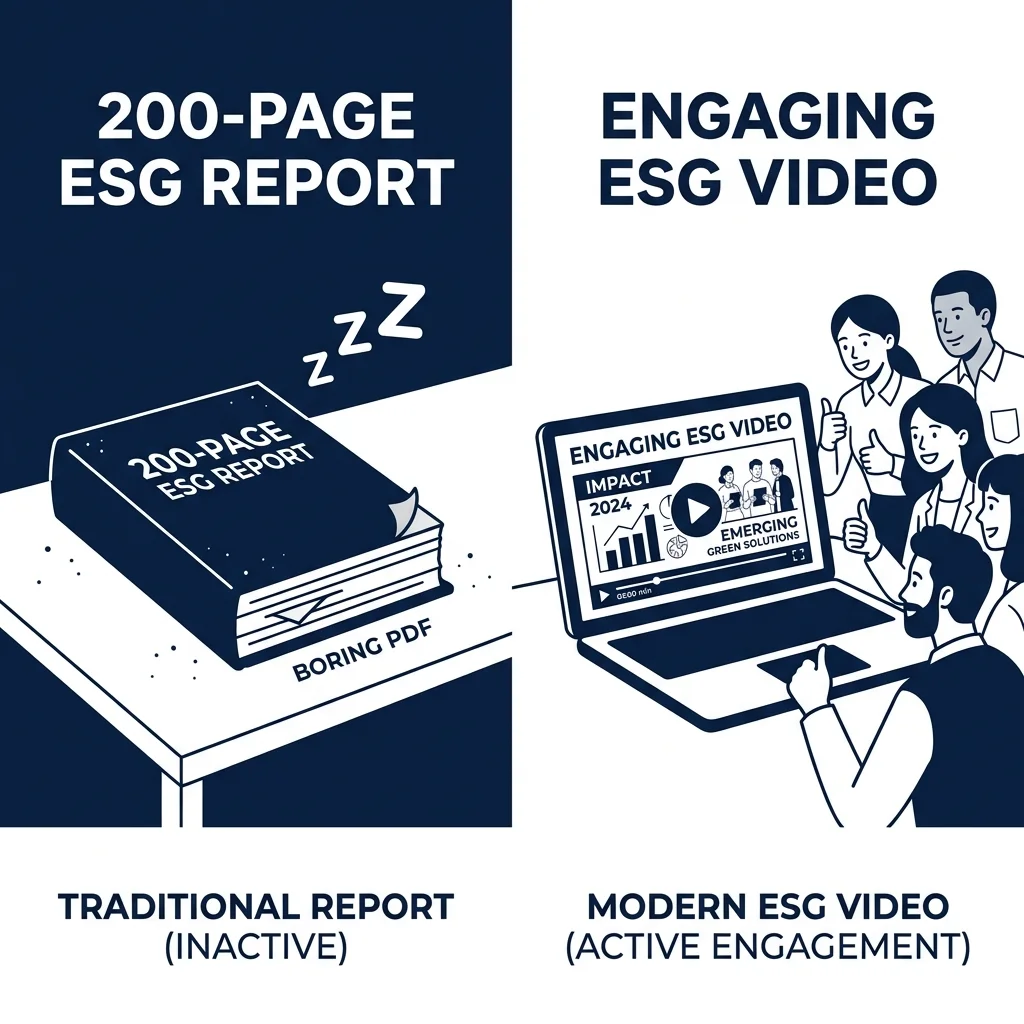
An ESG film turns a 200-page report into 3 minutes of content that employees will watch, investors will remember, and journalists will quote. It does not replace the report. It makes the report work.
💡 Key Takeaways (TL;DR)
- CSRD will cover 50,000+ companies in the EU by 2026 — ESG reporting is no longer optional, it is a legal requirement.
- An ESG film closes the gap between raw data and stakeholders: employees, investors and clients absorb audiovisual content 5x more effectively than text.
- Companies that communicate ESG through video build employer brand and reputational advantages over those who limit themselves to PDF documents.
- One professional ESG film serves multiple audiences simultaneously: board, employees, media, institutional clients.
What is CSRD and Why Does It Affect Your Business?
The Corporate Sustainability Reporting Directive replaced the earlier NFRD and radically expanded the circle of companies required to report. The timeline is specific:
- From 2024: Large listed companies previously covered by NFRD (over 500 employees)
- From 2025: Large non-listed companies meeting size thresholds (over 250 employees or €40M turnover)
- From 2026: Small and medium listed companies on EU stock exchanges
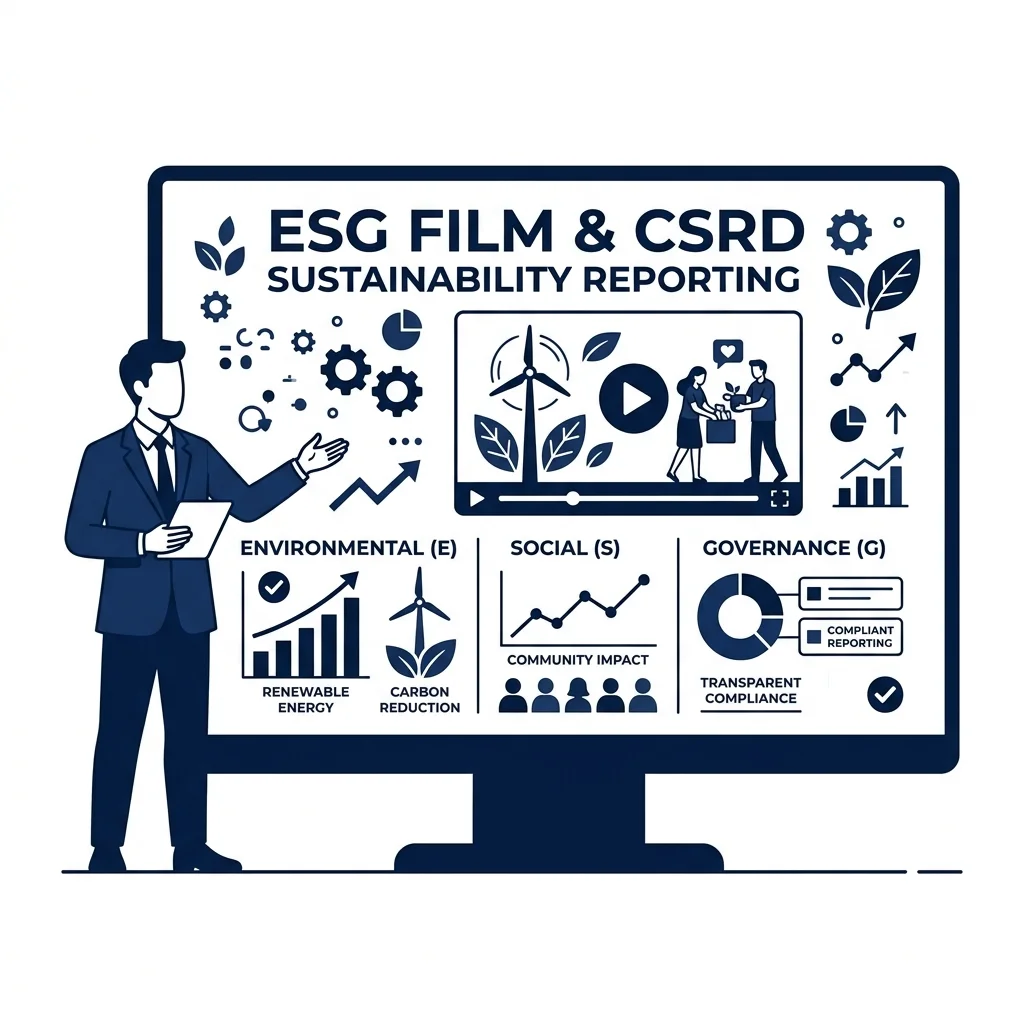
Reports must cover environmental matters (emissions, resource use, biodiversity), social matters (working conditions, human rights, local communities) and governance (board structure, ethics, anti-corruption). ESRS standards define precise requirements for disclosed data.
The challenge is not collecting the data. The challenge is what to do with it.
Why Reporting Alone Is Not Enough
An ESG report as a PDF reaches the legal department, the investor relations page and the archive. An analyst from a fund will read it, an auditor will check it, and perhaps one trade journalist will reference it. Your employees — the 3,000 people who either deliver on those values every day or do not — will never read it.
That is a communication gap that costs money. Companies spend hundreds of thousands on ESG consultants, external auditors and data collection systems — and end up with a document that changes no behaviour, builds no loyalty and distinguishes them in no market.
An ESG film closes that gap. It is not decoration for the report. It is a strategic communication tool that makes ESG work as a competitive advantage — not just as compliance.
Four Audiences That Need Different ESG Films
One film for everyone is a mistake. Effective ESG communication requires segmentation:
Institutional investors and ESG funds They look for evidence of a systemic approach to climate and social risk management. They need data in a narrative, not narrative without data. Format: 5–8 minutes, journalistic style, specific KPI indicators.
Employees and job candidates Gen Z and Millennials choose employers aligned with their own values. They want to see authentic actions, not beautiful declarations. Format: 90–180 seconds, employee stories, concrete initiatives.
B2B clients and public tenders An increasing number of contracts require ESG documentation. Film builds credibility faster than certificates. Format: 2–3 minutes, case studies of environmental actions, supply chain transparency.
Media and public opinion Journalists need ready-to-cite material. Format: 60–90 seconds, key achievements of the year, the voice of the CEO or Chief Sustainability Officer.
Case Study:
An industrial packaging manufacturer with 800 employees prepared their first CSRD report. The document was substantively correct, but management was concerned that none of the key stakeholders — employees, suppliers, clients — would ever engage with its content.
We produced three short films: an internal film for employees showing concrete factory initiatives (waste reduction, cycling programme, local biodiversity), a B2B client film about emissions tracking in the supply chain, and a 90-second highlight reel for media featuring the key numbers of the year.
The company secured three B2B contracts where ESG was an evaluation criterion. Employee retention increased 18% in the quarter following publication of the internal materials. The media film generated four press articles with no PR spend.
What Should an ESG Film Show?
The most common mistake: the company shows plans and declarations instead of actions and results. Candidates and investors recognise this immediately.
Instead of: "We aim for climate neutrality by 2040" Show: A specific production line where energy recovery was implemented, with the tonnes of CO2 reduced this year
Instead of: "We care about employee wellbeing" Show: An employee explaining how their workplace has changed over the last two years
Instead of: "We support local communities" Show: A project you completed, with the names of the people it affected
Specifics beat abstraction always. In an ESG film — even more so.
ESG Film and CSRD Requirements — Can Video Be Part of the Report?
Formally, the CSRD report must be a text document with numerical data in a defined ESRS structure. A film does not replace the report.
But ESRS does not prohibit supplementing the report with audiovisual materials. An increasing number of companies are placing links to ESG films directly in the report as supplementary materials — and this practice is growing. The film becomes the "living face" of the data.
Moreover: a report may live for one year. An ESG film — optimised for SEO and published on YouTube, LinkedIn and the IR page — generates traffic throughout the year, answers search engine queries, and is increasingly cited by AI tools responding to questions about specific companies.
How Much Does an ESG Film Cost and When Does It Pay Off?
Production cost depends on scope and the number of versions required. An ESG film is not a one-time expense — it is a communication asset that serves tenders, recruitment and investor relations for 2–3 years.
With a single B2B contract won where ESG was an evaluation criterion, one film pays for itself many times over. With ten employees who chose the company after watching an authentic film about its values — the return is beyond calculation.
Planning ESG communication for your company? Call: +48 663 393 700 or write to info@semastudio.pl — we will help design a video strategy tailored to your CSRD report.