How to Write a Corporate Film Script? 7 Steps to a High-Impact Script
How to Write a Corporate Film Script? 7 Steps to a High-Impact Script
A professional video script is the bedrock upon which every successful corporate film production stands. It is not merely about words — it is a strategic document that defines the message, the architecture, and the emotional impact of the entire film. Written correctly, it becomes the master map for the entire production unit. Written poorly, it triggers expensive fixes on set and in post-production.
Here are the 7 steps we deploy at Sema Studio when architecting scripts for our corporate clientele.
Step 1: Write the Video Brief
The brief is not a formality — it is the document that commands the entire production vector. An effective corporate brief answers: What is the strategic objective of this film? Who is the demographic target? Where will it be deployed? What emotions must it trigger? What is the brand's primary differentiator the film must communicate?
The more clinical the brief, the more effective the script. At Sema Studio, every production initiates with a collaborative briefing session with the client — because a superior film begins with a superior question. If you are still searching for a production partner or need a head start building your brief, download our ready-made video brief template and production contract guide.
Step 2: Narrate, Do Not Inform
The most frequent error in corporate film scripts: attempting to cram every piece of historical data about the firm into a single film. The result? Pure boredom. Audiences do not demand a list of facts; they demand a narrative they can identify with. Even the hardest B2B film functions superiorly when it possesses a protagonist, a conflict, and a resolution.
Step 3: Write in the Language of the Audience
A script intended for the board of a global corporation must sound fundamentally different than a film targeted at factory floor staff. Simplicity and the absence of corporate jargon are not weaknesses — they are a form of precision. C-suite audiences demand specifics, data, and clear-cut conclusions. Not time spent explaining the obvious.
Step 4: The Economics of the Word
In film, every word costs seconds. Ruthlessly avoid repetition, generalities, and sentences that can be excised without losing the core meaning. Stress-test every sentence with the question: what would happen if we deleted this? If the answer is 'nothing' — delete it. Message precision is the hallmark of films that maintain long-term retention.
Step 5: Think in Imagery, Not Words
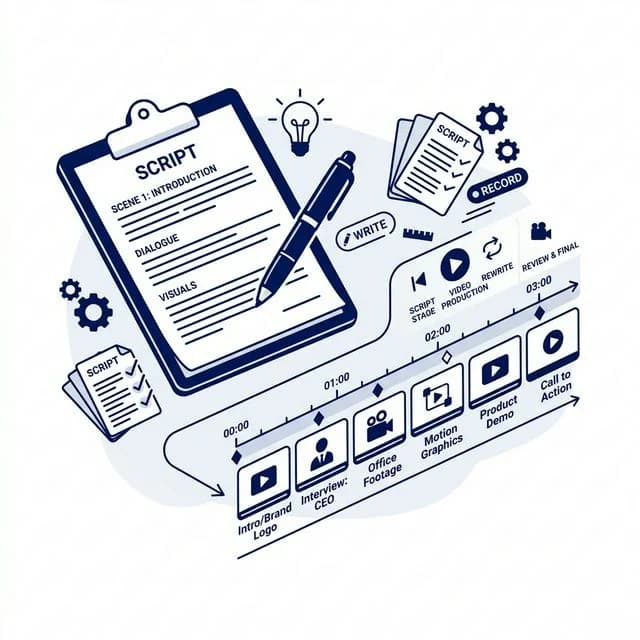
Film is a visual medium. A script must describe not only what the characters articulate, but primarily what the viewers will witness. Sounds, takes, camera movements, locations — all of this belongs in the script. At Sema Studio, every script is augmented with a preliminary storyboard visualising mission-critical frames.
Step 6: Read Aloud and Clock the Time
Read your finalized script aloud — and measure the time. On average, 125-150 words equate to one minute of footage. Reading aloud exposes artificial phrasing, unnatural transitions, and segments that look 'clean' on paper but fail to function on screen.
Step 7: Iterate and Finalize
Script genesis is an iterative process — version one is never the final version. The protocol: version one → client feedback → revision → content approval → final linguistic audit → sign-off by all stakeholders. In corporate productions, changes post-production are exponentially more expensive than changes made at the script phase.
💡 Key Takeaways (TL;DR)
- The bedrock of an effective script is a detailed and calculated brief.
- Narrate by showing actions (Show, Don't Tell) instead of reciting dry statistics.
- Every word used must transmit meaning; brevity positively impacts video dynamics.
- Reading dialogues aloud and utilizing storyboards eliminates artificiality and collapses the shooting schedule on set.
Case Study: Excessive Text vs. Advertising Metrics
A Software House produced a high-end but 'talky' film exceeding 5 minutes, in which staff spoke in technical jargon and detailed procedures for deploying their SaaS product. Retention rate was a catastrophic 10% after the first minute.
We condensed the script, distilling the entire technological message into an engaging story of a single brand facing a crisis. In 90 seconds, we focused on solutions using imagery and emotion without technical lexicography.
The film now relentlessly fuels sales funnels. Audiences began consuming it, expanding the retention rate from 10% to over 75% at the end of the material.
Frequently Asked Questions (FAQ)
How do I start writing if I have zero experience?
First, solve for your business objectives. Think about which specific slice of your operations or intel will be most mission-critical to transition a viewer into a client. Then, join us for a clinical briefing session.
To what degree does the script format undergo modification during the shoot?
The director will occasionally execute creative modifications and react with artistic invention to the live situation on set, but they never breach the core skeletal and narrative architecture of the document.
Do you assist with English-language copywriting?
Yes, at Sema Studio, we architect scripts for both domestic and global markets, collaborating with professional native speakers to match the precise dialect and slang of the target region.
A well-architected script is an investment that pays dividends at every subsequent stage of production. At Sema Studio, we offer a comprehensive script and video brief development service for corporate clients — contact us to discuss the mission details.
![How to Choose a Video Production Company in Wroclaw and Write a Brief [Template & Contract]](/_next/image?url=%2Fimages%2Fblog_generated%2Fblog_white_brief_umowa_wroclaw.webp&w=3840&q=75)