Music Video Production — How to Realize a Professional Music Video?
Music Video Production — How to Realize a Professional Music Video?
The music video is an art form that, since the 80s, has transformed how music is consumed, distributed, and remembered. In the era of YouTube, Spotify, and streaming platforms, a professionally realized music clip is to an artist and label what an advertising billboard was to brands in the television era — a visual business card that defines the image and strikes the heart of fans.
What Distinguishes Professional Music Video Production?
Music video production differs from other film genres primarily through its specific approach to visual narrative. A music video does not have to tell a linear story — it can be an abstraction, a performance, a short fiction film, or a documentary. It is united with other genres by one factor: every shot must be absolutely accurate and compelling.
Professional recording of music clips requires:
Extensive Creative Concept — A music video begins with an idea. Concept art, mood, color palette, props, costumes, locations — everything must be consistent and reflect the artist's aesthetic and musical message.
Script or Treatment — Even seemingly improvised music videos are precisely planned. A treatment (a several-page description of the concept) is the communication document between the director and the artist.
Professional Film Hardware — Broadcast-tier cameras (4K, 6K, RAW), lighting systems with full color control, gimbals and stabilizers, and optionally slow-motion (120-240fps) for dramatic effects.
High-Tier Post-Production — Editing synchronized with the music, color grading defining the mood, and special effects and VFX where the concept demands it.
Categories of Music Videos
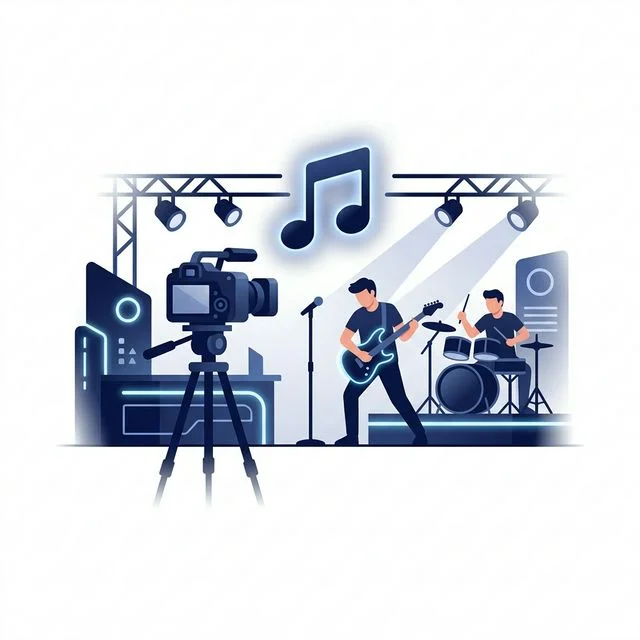
Performance — The artist performs the piece in a controlled environment (studio, stage, exterior). The simplest format, concentrated on the artist and the energy of the execution.
Narrative — A short film with a plot linked to the lyrics or mood of the song. Requires a cast, set design, and direction.
Animated — Realized partially or entirely in 2D, 3D, or motion graphics techniques. Costly, but offering limitless creative possibilities.
Documentary — Footage from concert tours, backstage, interviews, and scenes from the artist's life. An authentic format particularly valued by fans.
Hybrid — A fusion of two or more of the above formats. Most frequently deployed by artists with an extensive vision board.
Music Video Quoting
💡 Key Takeaways (TL;DR)
- A music video does not have to be a literal reflection of the song - it focuses more on metaphor and cinematic art, distilling the artist's allure into a single form.
- The bedrock of fluid recording is the Treatment - a calculated document defining the directorial artistic and aesthetic vector of the realized music clip.
- Diverse trends exist (e.g., performance with a band or documentary footage music videos) that can be matched to the budget and creative style.
- The final flash of quality is granted in Color Grading. Perfectly styled color layers grant the video a luxury flavor.
Case Study: Visual Styling of a Debutant Using a Hybrid Format
A new independent artist possessed a modest budget but a massive demand to stand out in the streaming market on a densely populated musical YouTube.
We engineered a music video drawing 70% from a performance supported by innovative, pulsing lighting in a single small studio and 30% from a dark 3D animation matched in post-production, maintaining a consistent fusion of arts.
The music video exceeded expected view counts in the premiere week, securing the attention of professional record labels (A&R) and leading to the signing of a lucrative publishing contract.
Frequently Asked Questions (FAQ)
How long does the production of a typical music video take?
Shooting typically occupies 1 or 2 working days on set (from dawn to dusk). Significantly more labor-intensive are pre-production and directorial editing and coloring, the preparation of which usually occupies approximately one month.
Do you possess your own film hardware and fashion warehouses?
We service our sets using uncompromising RED / ARRI cinema cameras along with a complete lighting package. Specific items such as FX makeup and costumes are sourced from proven external partners (Stylist, MUA) upon approval.
What are the trends, why do I keep seeing an analog film look?
Grafting 90s nostalgia onto music is an extremely powerful aesthetic trend due to nostalgia. Thanks to our workflow, we can very realistically reconstruct the magic of celluloid film layers in a sterile, modern 4K file.
The cost of music video production depends on the concept, number of shooting days, locations, cast, and demand tier of post-production. Quoting details are determined individually after reviewing the treatment or project brief — contact Sema Studio to discuss your project.