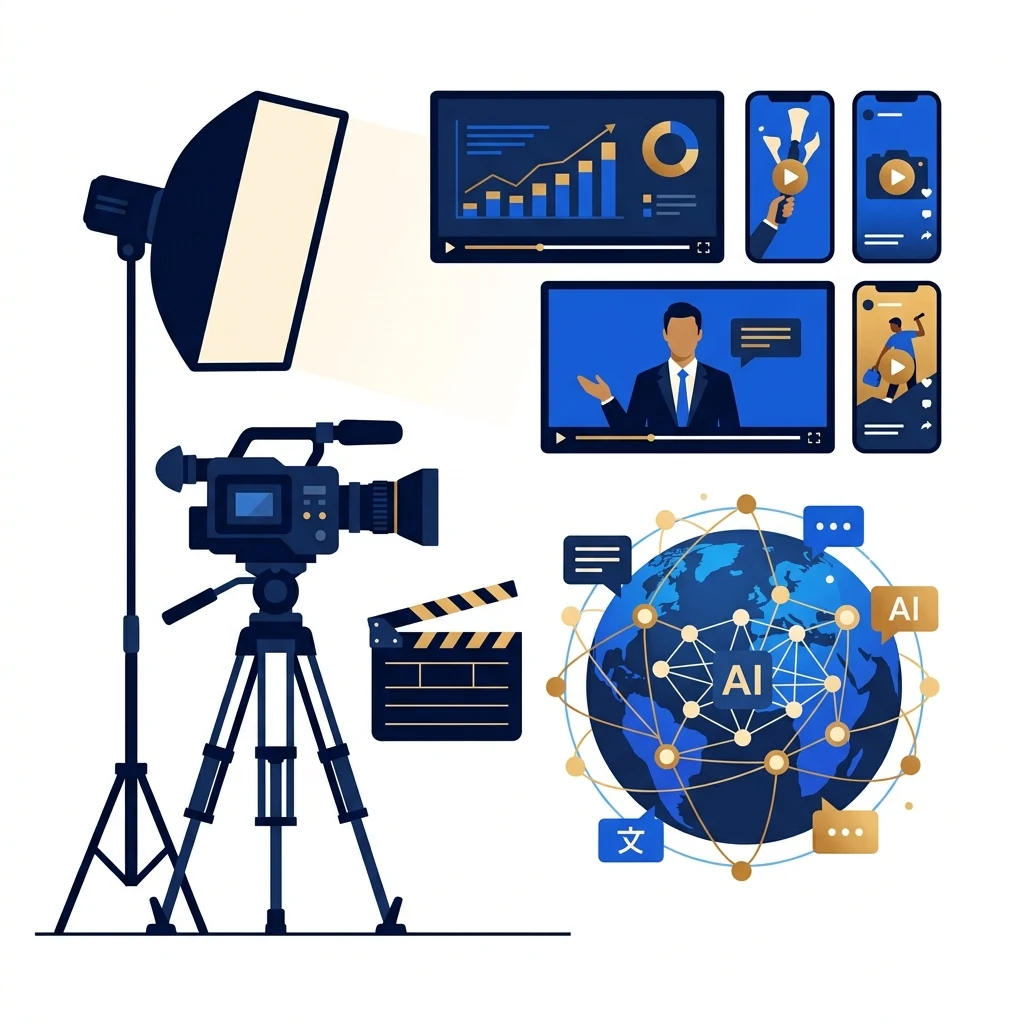
AI Localization in Corporate Video — How to Scale Your Message to 10 Markets Without 10 Extra Shooting Days

The Scale Problem You Know Too Well
You've just recorded a masterpiece with your CEO. Now you need to deploy it across German, French, Japanese, and Brazilian markets.
Your legacy options:
- Record a voiceover in every language + subtitles → Cheap, but it surgically removes the emotion and the hard-earned credibility of your executive.
- The CEO re-records every single version → 4 extra shooting days, 4 separate edits, and a massive drain on leadership time.
- Abandon localization → You forfeit the market.
None of these are viable. This is why AI Localization exists.
💡 Key Takeaways (TL;DR)
- Voice Cloning with Emotional Integrity: AI allows for the high-fidelity translation of video into another language while perfectly maintaining the specific vocal timbre of the original speaker (e.g., the CEO).
- Lip-Sync (Mouth Synchronization): The technology surgically aligns the speaker's lip movements to the new language, making the material appear staggeringly natural to the local audience.
- Human-in-the-Loop: AI is merely a power tool – to ensure the asset maintains brand safety, final verification must be executed by a professional director and a native speaker.
What Is It and How Does It Function?
Voice Cloning
Using 30-60 minutes of the CEO's original high-fidelity recording, the model builds a digital twin of their vocal profile. The voice sounds identical to the original — matching intonation, tempo, and character — but it articulates in a foreign language.
Critical: a voice clone is engineered exclusively with the explicitly documented written consent of the individual. Strictly no exceptions.
Lip-Sync
The algorithm surgically manipulates the mouth movements in the footage to align with the new audio track. The effect: the observer witnesses the individual speaking "naturally" in the target language.
Lip-sync quality is dictated by:
- The fidelity of the source material (lighting, resolution).
- The metric of rhythmic variance between languages (e.g., Polish → Japanese is a high-difficulty transition).
Auto-Subtitles
Subtitles are generated and synchronized with machine speed — with the mandatory requirement for subsequent editing and verification by a native speaker.
Where Does the Hard Boundary Lie?
Not all content is an appropriate candidate for AI Localization. To be honest:
| Excels At | Struggles With | |---|---| | Corporate CEO/CFO reports | High-gesticulation interviews | | ESG / Annual Reports | Conferences with many overlapping speakers | | Training and onboarding | Assets < 1 min (insufficient sample size) | | Landing page video | Comedic or highly improvised content |
Our Model: Supervised by Humans at Every Step
At Sema Studio, AI Localization is an instrument, not an automaton. Every single localization passes through:
- Native verification of the voice clone's high-fidelity quality.
- Frame-by-frame lip-sync correction in critical narrative junctures.
- Translation correction by a native speaker or a specialized industrial translator.
- Final Quality Control (QC) by our lead director.
The reduction in localization capital requirements can reach up to 60% compared to legacy multi-language productions.
Case Study:
Mini Case Study: Global Transformation for a Tech Powerhouse: A Polish software leader entering the DACH market (Germany, Austria, Switzerland) faced the brutal necessity to record German versions of 15 key webinars and product presentations.
The legacy model would have required a Berlin agency, a German actor, and 4 high-cost studio days. Instead, we executed a synthetic localization (AI Voice Cloning + Lip Sync) of their existing, top-tier English recordings (alongside synchronized subtitling).
Capital requirements slashed by nearly 60%, and Time-to-Market collapsed from 2 months to a mere 2 weeks.
Want to witness how your asset would behave after localization? Let's talk.
Frequently Asked Questions (FAQ)
Is voice cloning 100% legal and enterprise-secure?
Yes. We execute these processes exclusively after hardening rigorous legal consents with the individual being translated. Our toolsets guarantee data privacy and do not train models on your proprietary data for third parties.
What languages can be synthetically localized?
Current technology allows for elite translation and lip-sync across the most dominant business languages – from English, German, French, and Spanish to Asian (Japanese, Korean) and Arabic.
Is a smartphone recording sufficient for high-end lip-syncing?
No. AI algorithms function correctly only on professional, high-resolution recordings with stable, studio-grade facial lighting and clinical audio from a close-proximity microphone. Low baseline quality will cause the generated facial mask to disintegrate, creating an unacceptable 'glitch' effect.