Logo Animation — Why Every Corporation Needs an Animated Brand Identity?
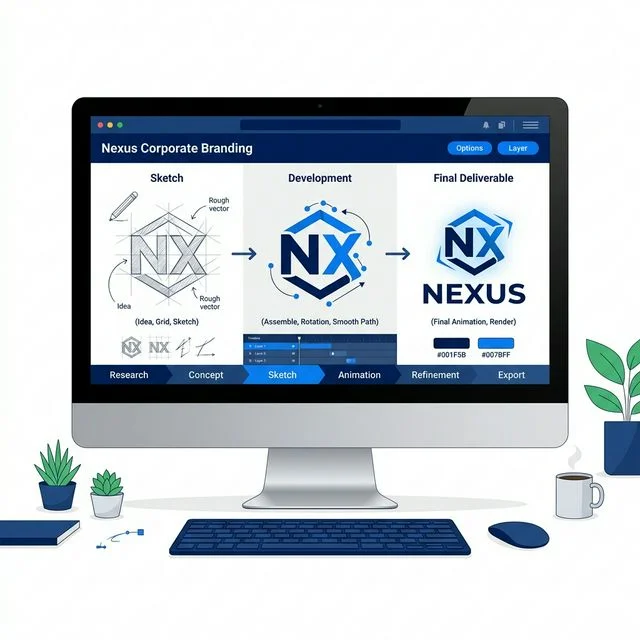
Logo Animation — Why Every Corporation Needs an Animated Brand Identity?
The human brain is hardwired to react most aggressively to motion and light. This is an evolutionary mechanism that, for millions of years, has directed human attention toward changes in the visual field. Logo animation is the direct application of this mechanism to build brand recognition — and that is why it is a tool no serious corporation should operate without in the video era.
💡 Key Takeaways (TL;DR)
- Building Brand Recall: Dynamically closing corporate films with a logotyp guarantees a massive spike in audience memory retention compared to a static 'business card' frame.
- Corporate Modernity: A 3-second logo intro positions the company in the premium segment before the speaker even delivers the first line of content.
- Bespoke Design: Generic animations and 5-dollar stock templates destroy the image of large B2B firms; professional motion design must be strictly anchored in the vector grids of the brand's identity.
What Is Logo Animation and Why Does It Work?
Logo animation (animated logo, logo sting, logo reveal) is a short motion graphics sequence presenting the company's logotyp in a dynamic, visually arresting manner. It typically lasts from 2 to 5 seconds and appears as an intro or outro in every video asset produced by the firm.
A static 2D logo placed in the footer of a presentation is merely noticed. An animated 3D logo closing a professionally realized corporate film is remembered. This is the critical difference in the process of building brand recall.
Types of Logo Animation
2D Logo Reveal — A fluid unveiling of the logotyp using opacity, slide, and morph effects. Elegant, fast to produce, and ideal for brands with minimalist visual identities.
3D Logo Animation — A three-dimensional visualization of the logotyp with realistic materials, lighting, and shadowing. The highest level of visual prestige — the standard in corporate productions for global brands.
Kinetic Type Animation — Fusing an animated logotyp with dynamic text. Effective for brands whose strength lies in their slogan or claim.
Particle Logo — A logo that constructs itself from particles, dust, or lighting effects. Spectacular, frequently utilized in technology and premium-tier industries.
Logo Animation as an Element of Brand Consistency
Every corporate film, every executive presentation, and every training asset should conclude with the same, recognizable brand identifier. This visual consistency builds brand recall — even if the viewer only remembers the final 3 seconds of the material, those 3 seconds are your logo.
Modernizing an Existing Logo
If a firm has operated for years and its logo is well-recognized, a complete overhaul of the visual identity can often cause more damage than benefit. Adding animation to an existing logo is a solution that does not disorient current clients while simultaneously granting the brand a modern, dynamic character. Every logo — without exception — can be animated.
Case Study:
Mini Case Study: Image Revitalization via Intelligent Motion Design: During a minimal rebranding for a financial corporation, one of the smaller but boldest steps was commissioning a video for internal training.
We opened their format with a 4-second animation unlocking the brand's new colors, encased in glass textures and a subtle ambient sound strike (Sound Design). The result surpassed expectations when the material triggered high rates of refreshment and brand pride among internal staff after a period of stagnation, raising the eNPS score by several critical points.
This is the most cost-effective marketing intervention available to a corporation that triggers a noticeable image ROI.
The Capital of Logo Animation
The cost of logo animation depends on the level of technical depth (2D vs. 3D), the duration of the animation, the volume of variations required (light/dark backgrounds, different aspect ratios), and specific brand requirements. At Sema Studio, we quote every project individually. Contact us to discuss the details of your vision.
Frequently Asked Questions (FAQ)
How long does it take you to design a professional animated version of a logotyp?
For a simple 2D vector composition, the drafting and assembly time averages a few business days. For complex 3D renders and multi-element 'particle reveals', we typically estimate a minimum of 2 weeks, including a full design phase for the master frames.
Do I need to deliver the logotyp in a specific software format?
Yes, open vector files (e.g., .Ai, .EPS, .SVG) are absolutely ideal. This significantly accelerates the workflow for our motion designer by eliminating the need to painstakingly re-trace low-quality graphics, which would otherwise generate hidden budget costs.
![How to Prepare Your Company for a Film Crew? [Shoot Day Checklist]](/_next/image?url=%2Fimages%2Fblog_generated%2Fblog_white_jak_przygotowac_firme_checklista.webp&w=3840&q=75)