How Much Does a Bad Hire Cost — and How a Recruitment Video Fixes It
How Much Does a Bad Hire Cost — and How a Recruitment Video Fixes It
An employee quits after three weeks. Or after one day. They went through two rounds of interviews, signed a contract, got a laptop, completed onboarding — and then they disappear. In the best case, they send a polite resignation. In the worst, they simply do not show up on Monday.
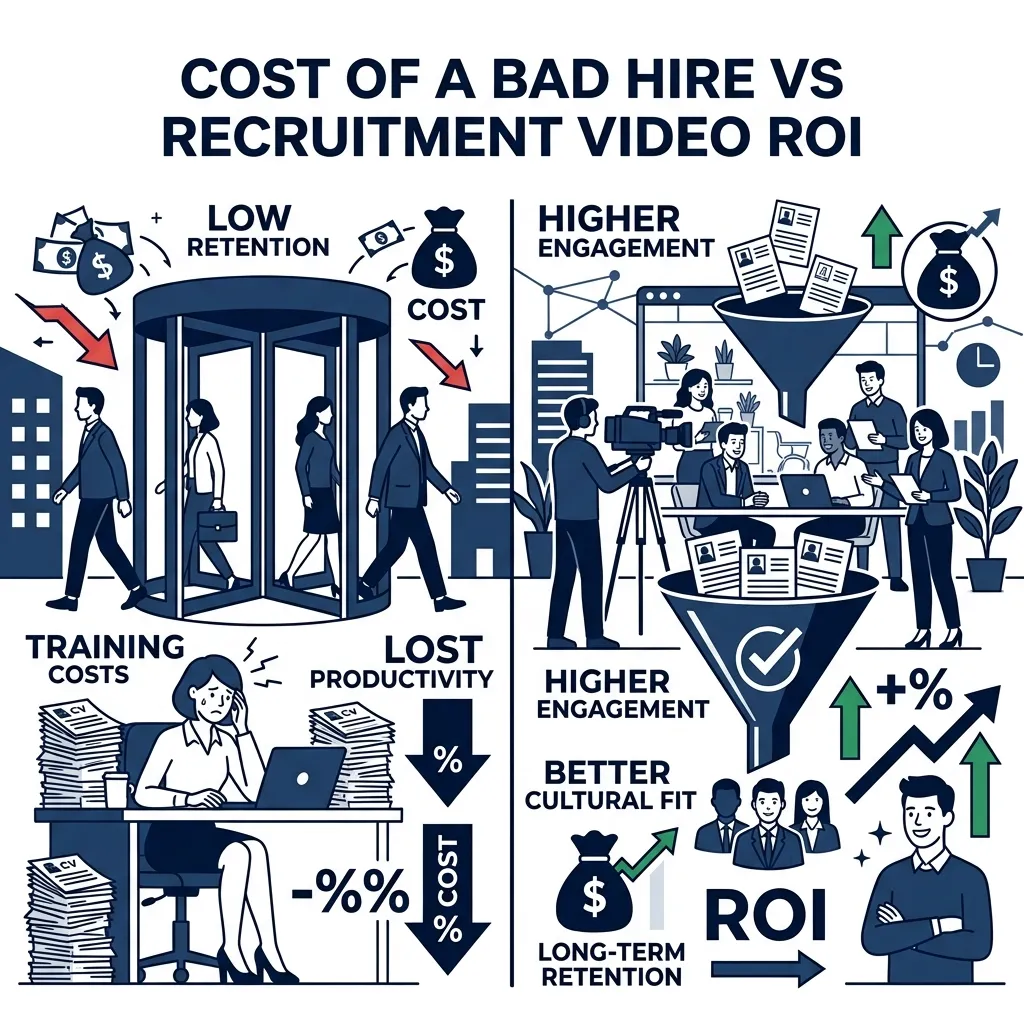
For most companies, this is not an exception. It is a recurring scenario that costs real money. A single failed hire absorbs 30% to 200% of the annual salary for that position — depending on the seniority and industry. For specialist roles, that can be the equivalent of throwing €15,000–50,000 away before anyone produces a single deliverable.
A recruitment video is one of the few tools that attacks this problem before the first interview ever happens. Not because it attracts more candidates — but because it repels the wrong ones.
💡 Key Takeaways (TL;DR)
- A failed hire costs 30–200% of annual salary, including HR time, onboarding, lost productivity and repeat recruitment.
- The main cause of early departures: the candidate did not know what they were getting into. A recruitment video eliminates that surprise before the CV is even submitted.
- Self-selection mechanism: candidates who do not fit the company culture opt out after watching an authentic video — before consuming any HR resources.
- Training savings: a new hire who has already seen what the job looks like absorbs onboarding 35% faster and stays longer.
The Real Cost of a Bad Hire — Numbers That Make an Impression
Most companies calculate recruitment cost as: job ad + recruiter time. That is a misunderstanding. The full cost of a failed hire looks like this:
Recruitment phase:
- HR time for CV review, interviews, feedback — 20–40 hours
- Cost of job ads and any agency fees — €1,000–5,000
- Manager time for interviews and evaluation
Employment and onboarding phase:
- Salary paid for the time the employee spent at the company
- Onboarding time — buddy, manager, IT, administration
- Access setup, equipment, environment configuration
- Initial training, compliance, procedures
Hidden costs after departure:
- Lost productivity of the vacant position
- Team demoralisation from onboarding someone a second time
- Potential negative reviews on LinkedIn or Glassdoor
The total? For a specialist role with a monthly salary of €3,000, a failed hire that ends after three weeks can realistically cost €8,000–18,000. Three such cases in a year is the budget for a quality recruitment video — one you can use for the next three years.
Why Do Employees Leave So Soon After Being Hired?
SHRM research indicates that 80% of early turnover stems from expectation mismatch — not from lack of skills. The candidate had a different picture of what working at the company would be like. A different pace, different culture, different management style than what they read in the job ad and heard in the interview.
A job posting is a marketing document written by HR. A job interview is a two-way image game — the company sells itself, the candidate sells themselves. Nobody tells the whole truth. The result: the first weeks become a collision with reality that leads some people to leave quickly.
A recruitment video breaks this pattern. An authentic film shows the office unretouched, real people without a script, the actual pace and character of the work. A candidate who watches it sees what is coming — before they ever send their CV.
The Self-Selection Mechanism — the Most Valuable Feature of a Good Recruitment Video
Here is a paradox that sounds counterintuitive at first: a good recruitment video reduces the number of applications.
That is precisely the point.
Instead of 200 CVs where 190 are a waste of time — you get 60 CVs, of which 50 are people who saw what working at your company is really like and consciously decided they want it. Candidates who do not fit the culture, the pace, the management style — they opt out after watching. No interview. No onboarding. No cost.
That is self-selection. And it is worth more than any psychometric test.
Case Study:
A logistics company with 400+ employees was losing around 30% of newly hired drivers and warehouse workers within the first 60 days each year. Every departure triggered a costly cycle of recruitment and repeat onboarding.
Instead of another job ad campaign, we filmed an authentic video showing the reality of warehouse work — night shifts, pace, physical demands, the team dynamic. No polishing. The video became the first point of contact with every candidate across all recruitment channels.
Early turnover in the first 60 days dropped 55% over two quarters. Candidates who applied after watching the video knew what they were getting into — and stayed. The company saved an estimated €30,000 per year in repeat recruitment costs.
The Training Effect: A New Hire Who Already Knows Gets Up to Speed Faster
Self-selection is the first effect. The second is less obvious but equally measurable.
An employee who saw an authentic video about the company before joining absorbs onboarding differently. They do not spend the first week adjusting to the organisational culture, being surprised by communication styles, or searching for answers to questions they should have asked earlier.
They already know. They are mentally past the adaptation phase. They can focus on substance, tools, tasks.
Aberdeen Group research shows that employees who go through structured onboarding supported by video materials reach full productivity 60% faster than those onboarded solely through meetings and documents. They also retain 5× more knowledge from audiovisual materials than from text.
For the company, this translates directly: shorter time to first real value from a new employee, less manager time spent repeating the same explanations, standardised onboarding knowledge regardless of who is doing the onboarding.
Recruitment Video vs. Training Video — What Is the Difference?
It is worth distinguishing two roles of video in the hiring process, because both save money — but at different points:
Recruitment video works before hiring. Its purpose is to eliminate mismatched candidates and attract the right ones. It saves on recruitment costs and early turnover.
Training / onboarding video works after hiring. It standardises knowledge, accelerates onboarding, and eliminates the need for individual sessions with experts. It saves manager and trainer time.
They work best together — as a coherent communication system from first candidate contact through to full employee productivity. The candidate sees the recruitment video, decides they want to work there, applies with awareness. After being hired, a series of onboarding videos is waiting — day one, procedures, tools, culture.
How Much Does a Recruitment Video Cost and When Does It Pay Off?
A recruitment video is a one-time investment you use for 2–3 years. Assuming a company fills 10–20 positions per year and a single wrong choice costs €10,000 — eliminating even two bad hires per year completely covers the production cost.
This is not marketing. This is workforce risk management.
One important point: a recruitment video does not need to be expensive to work. It needs to be authentic. A corporate production with actors and rehearsed lines will have the opposite effect — attracting candidates who believe the idealised picture and leave when they meet reality. What you want is raw truth told with a good camera eye — not a commercial.
What Should a Good Recruitment Video Show?
- The real workplace — not a conference room staged for a shoot, but the everyday office, warehouse or production floor
- Real employees — without a script, asked what genuinely motivates them and what surprised them
- The reality of the work — the pace, communication style, demands, what is hard and why it is worth it
- The actual culture — not "we value people and innovation", but what team relationships really look like
- The candidate journey — what happens after the CV is submitted, what the interview looks like, how onboarding works
A candidate who still wants to apply after watching that video — is a candidate who fits. And will probably stay.
Want to know how many failed hires your company made last year and what it cost? Call: +48 663 393 700 or write to info@semastudio.pl — we will help you calculate the ROI and plan a video that changes it.