Camera Crane — How Jib Arm Shots Elevate Corporate Film Quality
Camera Crane — How Jib Arm Shots Elevate Corporate Film Quality
In international-level corporate film production, every shot must be strategically justified. The camera crane — also known as a jib arm or camera boom — is one of those hardware elements that instantly grants a production a cinematic character and visual depth unattainable via a traditional tripod. It is a tool that shifts the perspective — both literally and figuratively.
What Is a Camera Crane and How Does It Function?
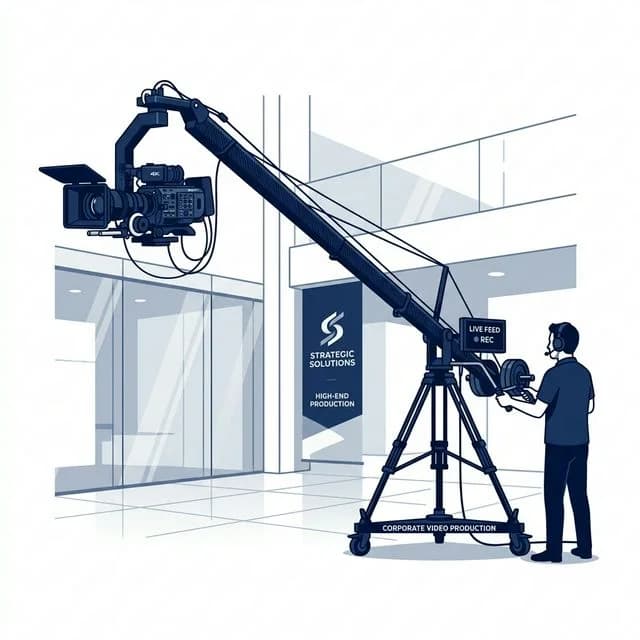
A camera crane is an arm or boom upon which a cinema camera is mounted. Utilizing a counterweight system and the capability for 3-axis rotation, the crane allows for fluid, controlled camera movement — up, down, sideways, and in an arc. The effect? Shots that are physically impossible to execute with any other ground-based equipment.
The fulcrum on the boom enables balanced vertical movement, while the base can rotate from left to right. Professional film cranes are equipped with remote heads, allowing the operator to command the frame and focus without directly touching the camera.
Strategic Applications of Crane Shots in Corporate Films
Opening and Closing Sequences — A camera crane excels in the first and final shots of a film. Slowly descending towards the firm's headquarters or rising above a production floor builds context and scale in a way that immediately communicates prestige and operational magnitude.
Space Visualization — In corporate films realized in manufacturing halls, logistics centers, or modern office campuses, crane shots allow for the capture of an object's scale in a single, fluid motion. No amount of static editing can replicate this effect.
Interview and Testimonial Scenes — A subtle crane rise during a speaker's statement grants the shot cinematic depth and dynamism without distracting from the content.
Corporate Events and Conferences — Shots flying over a conference hall or a crowd of event participants create a sense of scale and institutional prestige.
Categories of Camera Cranes in Professional Production
Cranes are available in vastly different dimensions — from compact jib arms (1.5-2 meters in length) operated by a single person, to massive crane systems utilized for broadcast-tier realizations. At Sema Studio, we possess cranes optimized for various production environments — from corporate interiors to sprawling exteriors.
Practical Intel for Production Managers
Working with a camera crane requires high-level planning. Here are several core rules:
Plan the location in advance — a crane demands significantly more volume than a tripod, and its assembly is time-intensive. An incorrectly selected location can cost hours of production time. Always establish the exact movement vector before initiating recording — and stress-test it without the camera rolling first. Calibrate the head to the specific weight of the camera and lens — an unbalanced crane generates visual jitter.
💡 Key Takeaways (TL;DR)
- A camera crane (jib arm) introduces irreplaceable, cinematic image dynamics through fluid vertical and lateral motion.
- It is ideal for wide establishing shots showcasing the magnitude of manufacturing halls or corporate skyscrapers.
- Utilizing booms during business events instantly spikes the prestige of the realized video coverage.
- Efficient use of a crane on set requires a prior site visit (recce) and high-fidelity pre-production planning.
Case Study: Capturing the Scale of a Production Line
An automotive sector manufacturer wanted to showcase its new, gargantuan assembly line. Handheld operator attempts and drone footage failed to capture the spatial relationship between workers and machinery in a cinematic way.
We measured the halls during pre-production and deployed a professional camera crane with a remote head. The fluid movement of the camera gliding 4 meters above the ground allowed us to showcase the process almost simultaneously from close-up and wide-angle perspectives.
The film captivated foreign investors, proving the monumentality and clinical precision of the technological process. Dynamic crane shots became a permanent fixture in the brand's premium communication.
Frequently Asked Questions (FAQ)
Why is a camera crane superior to an FPV drone?
A crane offers absolute stabilization utilizing the heaviest, uncompromising cinema cameras. It can operate extremely close to a subject's face and then, in the same fluid motion, rise 5 meters into the air.
How do we determine if our firm can accommodate a crane in the hall?
During the project planning stage, our crew executes an on-site 'recce' (location audit), verifying floor load capacity, lighting, and the volume necessary for the boom operator.
Does renting a crane significantly inflate the production budget?
This is hardware operated by a dedicated technician; however, the cost increase is perfectly balanced by the elite character it grants the film. We typically add it to quotes for complex premium productions.
A camera crane is an investment in the visual tier of your production that is immediately apparent on screen. At Sema Studio, we deploy it where it has strategic justification — and where it transforms a good film into an exceptional one.