Why International Hires Quit in Week One, and How Honest Video Fixes It

Relocating qualified industrial workers from the Philippines, India, Nepal, or Latin America to manufacturing hubs across Europe is an intricate logistical campaign. Visa processing consumes 3 to 6 months, and total acquisition costs per CNC machinist, welder, or assembly technician — factoring agency commissions, consular fees, flights, and initial lodging — easily run €3,500 to €6,000.
Then comes week one.
The worker lands in the bleak drizzle of November, arrives at a noisy industrial facility running a rigid three-shift system, and realizes reality bears zero resemblance to the glossy promises made by local recruiters in Manila or Mumbai. Within seven days, they resign, demand a flight home, or abscond to another employer.
The budget is incinerated, the station stands vacant, and the operations manager scrambles to meet contractual deadlines.
The antidote isn't another corporate brochure. Leading global manufacturers rely on a proven industrial psychology methodology: the video Realistic Job Preview (RJP).
💡 Key Takeaways (TL;DR)
- Early international turnover (the 'quit in week one' syndrome) stems from an expectation gap created by overseas staffing brokers.
- Losing a foreign recruit within their first month wastes €3,500 to €6,000 in sunk visa processing, flights, and stranded production capacity.
- A video Realistic Job Preview (RJP) shows unfiltered reality: actual plant noise, ambient microclimate, shift tempos, staff housing, and winter weather.
- One authentic production asset in the candidate's language serves dual duty: a recruitment filter before departure, and day-one onboarding material.
The Anatomy of Disillusionment: Why Foreign Recruits Leave
Early quits in manufacturing are rarely caused by laziness or deficient manual skills. They are caused by operational culture shock.
Local recruitment agencies in source countries frequently show candidates stock photography of gleaming Silicon Valley offices or cleanroom laboratories to secure their commission. Candidates from tropical climates arrive expecting light duties in climate-controlled spaces, only to confront:
- Hostile or Demanding Microclimates: Cold-storage food processing (4°C), heavy foundry environments, or cavernous facilities with continuous 85 dB machinery noise.
- Rigid Shift Discipline and Takt Times: Fast-paced assembly lines paced to 45-second cycle times, standing for 8 hours, and rotating weekend night shifts.
- Daily Living Logistics: Shared dormitory accommodation, 40-minute company bus commutes, and navigating temperatures well below freezing.
When these surprises hit on day one, workers feel misled and anxious. However, when candidates experience these exact conditions on video before signing their contract, a powerful psychological self-selection mechanism occurs: those unprepared opt out in Manila or Delhi — before thousands of euros are spent on visas and airfares.
We discussed the devastating economics of misaligned hiring in our analysis on the cost of a bad hire and recruitment video.
What Is a Realistic Job Preview (RJP) Video?
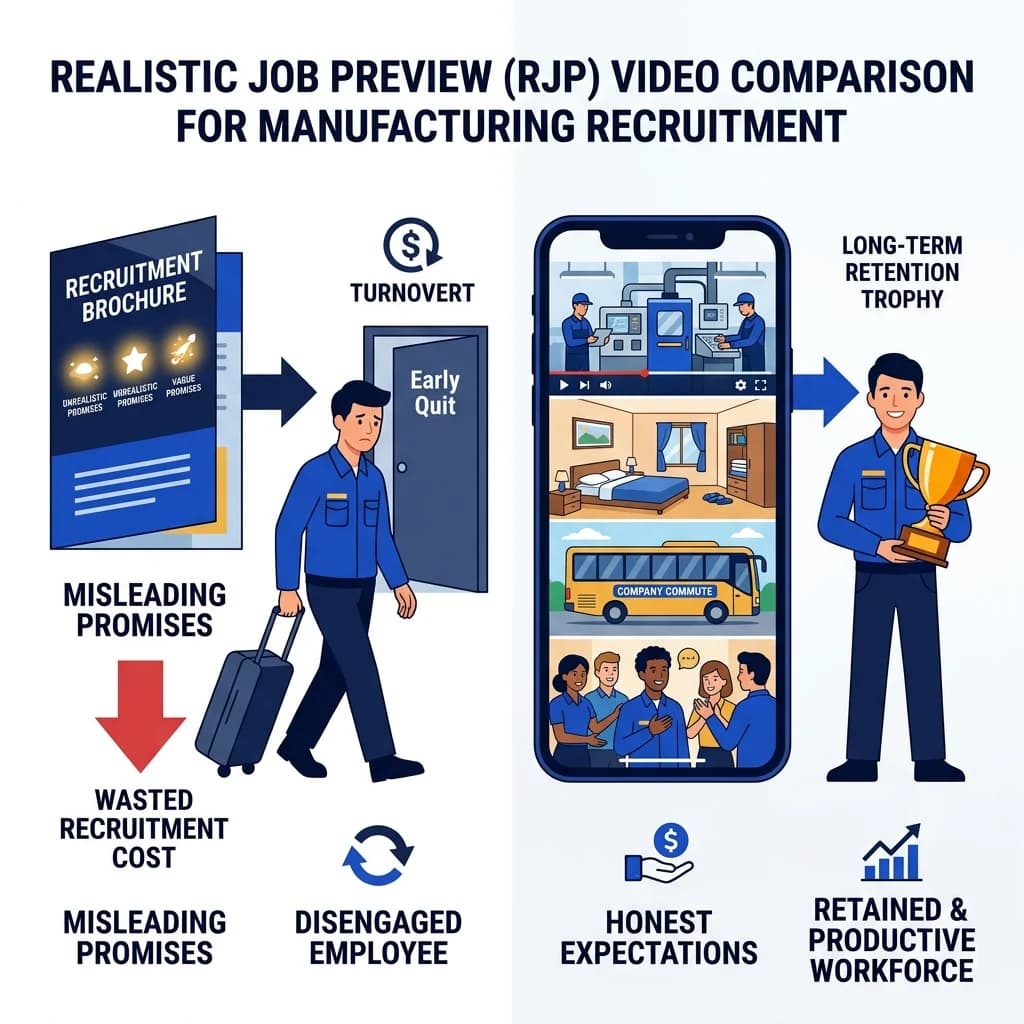
A Realistic Job Preview deliberately balances both the rewarding and demanding aspects of an industrial role. Video is the ultimate vehicle for RJP because a camera lens cannot fabricate authentic factory conditions.
At Sema Studio, an effective international recruitment film covers five essential pillars:
1. Genuine Floor and Workstation Realities
No cosmetic stage-lighting. We capture authentic assembly lines, mandatory personal protective equipment (heavy footwear, eye protection, ear defenders), and physical task repetitions. If the position requires lifting 15 kg castings, we show it clearly.
2. Lodging and Commute Transparency
We film employee living quarters, kitchens, laundry facilities, and shuttle pick-up points. Candidates see exactly where they will sleep, cook, and buy groceries.
3. Climate Preparation and Wardrobe
For workers from Southeast Asia, European sub-zero winters are an unknown reality. The video explains seasonal shifts, the thermal workwear provided by the company, and life outside the facility.
4. Direct Peer Testimonials in Native Languages
This is the single most persuasive trust-building factor. A foreign worker who has been with the plant for two years speaks directly to the camera in Tagalog, Hindi, or Spanish: “The first winter and the physical tempo were tough adjustments. But wages are paid on time to the penny, housing is covered, and the local coordinator assists with all legal paperwork.” Discover our approach to authentic testimonial videos and employee interviews.
5. Health, Safety and Plant Protocol
We outline safety boundaries, immigration rules, residency card procedures, and facility conduct codes to set expectations before arrival.
The Turnover Equation: Calculating Real Savings
Let's model the annual impact for an industrial plant hiring 50 international workers per year:
| Metric / Cost | Traditional Sourcing (Brochures / Third-Party Agents) | Video Realistic Job Preview (RJP) Strategy | |---|---|---| | First-Month Early Quit Rate | 25% (12–13 workers quit) | Under 5% (2–3 workers) | | Sunk Visa, Agency & Travel Losses | 12 workers × €4,000 = €48,000 | 2 workers × €4,000 = €8,000 | | Ramp-Up Time on Station | 4 weeks (delayed by anxiety & communication gaps) | 1.5 weeks (pre-departure video onboarding) | | Investment in Custom RJP Video Package | €0 | €6,000 – €8,500 (one-time asset) | | Net Operational Savings (Year 1) | — | Net Savings: ~€33,000+ |
The entire production investment pays for itself the moment just two international technicians remain on the job instead of flying home.
Case Study: Automotive Tier-1 Sub-assembly Supplier
The company sponsored 30 electro-mechanical assemblers from the Philippines. Within three weeks, 8 employees resigned, citing exhaustion on high-speed lines and severe adjustment difficulties. Total recruitment and logistics losses exceeded €35,000.
Sema Studio produced a 12-minute modular RJP video in English and Tagalog featuring veteran Filipino workers at the client's plant. The film detailed the 45-second takt time, break rotations, dormitory layouts, and regional support networks. Partner agencies in Manila made watching the video and signing an acknowledgement form mandatory prior to visa submission.
Across the subsequent cohort of 45 relocated workers, zero employees quit during their first quarter. Sourcing partners reported significantly higher candidate engagement, and initial on-site training duration dropped by 40%.
How to Integrate an RJP Video into Your HR Pipeline
- Operational Friction Audit: We consult shift managers and HR leads to identify the primary triggers of early quits: temperature, cadence, or dormitory rules?
- Cinema Shoot Day on Location: We capture genuine floor processes, living facilities, and peer interviews on site.
- Multilingual AI & Native Localization: Audio tracks and localized subtitles are rendered for target recruitment corridors (English, Tagalog, Hindi, Spanish, Ukrainian).
- Pre-Visa Gatekeeper: Partner agencies provide the private video link as a prerequisite for formal visa sponsorship.
- Day-One Induction: The identical asset anchors day-one orientation, streamlining safety procedures. Review our methodology for video onboarding and HR automation.
Frequently Asked Questions (FAQ)
Frequently Asked Questions (FAQ)
Won’t showing realistic difficulties scare away all potential candidates?
It only filters out candidates who would have resigned within their first week anyway — saving your company thousands of euros in non-refundable visa and airfare costs. Genuine, motivated workers respect transparency, resulting in significantly higher long-term loyalty.
How many language versions should we produce?
English serves as the baseline, complemented by localized voice tracks or subtitles in candidate native languages (such as Tagalog, Hindi, Spanish, or Ukrainian). Modern AI workflows make multi-language expansions straightforward and cost-effective.
Can agency-contracted employees appear in the video?
Yes, provided standard talent release agreements are signed. Our team provides complete legal release documentation compliant with GDPR and international labor regulations.
What is the typical production timeline for an international RJP video?
Production generally requires 1 shoot day across plant floors and accommodations. Final edited deliverables in multiple languages are typically ready within 2 to 3 weeks.
Can this video also serve domestic employer branding?
Absolutely. Showcasing inclusive multicultural operations, safe manufacturing standards, and structured onboarding strengthens employer reputation across European talent markets.
Stop Early Workforce Churn Before Recruits Leave the Airport
Do not let recruiting miscommunications siphon capital and operational momentum from your plant. Invest in honest, cinematic video that filters, educates, and inspires from day one.
Review our corporate portfolio under recruitment video production, read about our industrial capabilities at video production Poland, or request an estimate through our Briefing Room. We will help you build an onboarding video that secures lasting operational stability.