When Your Best Engineer Retires: Capturing Expert Knowledge with Video and AI
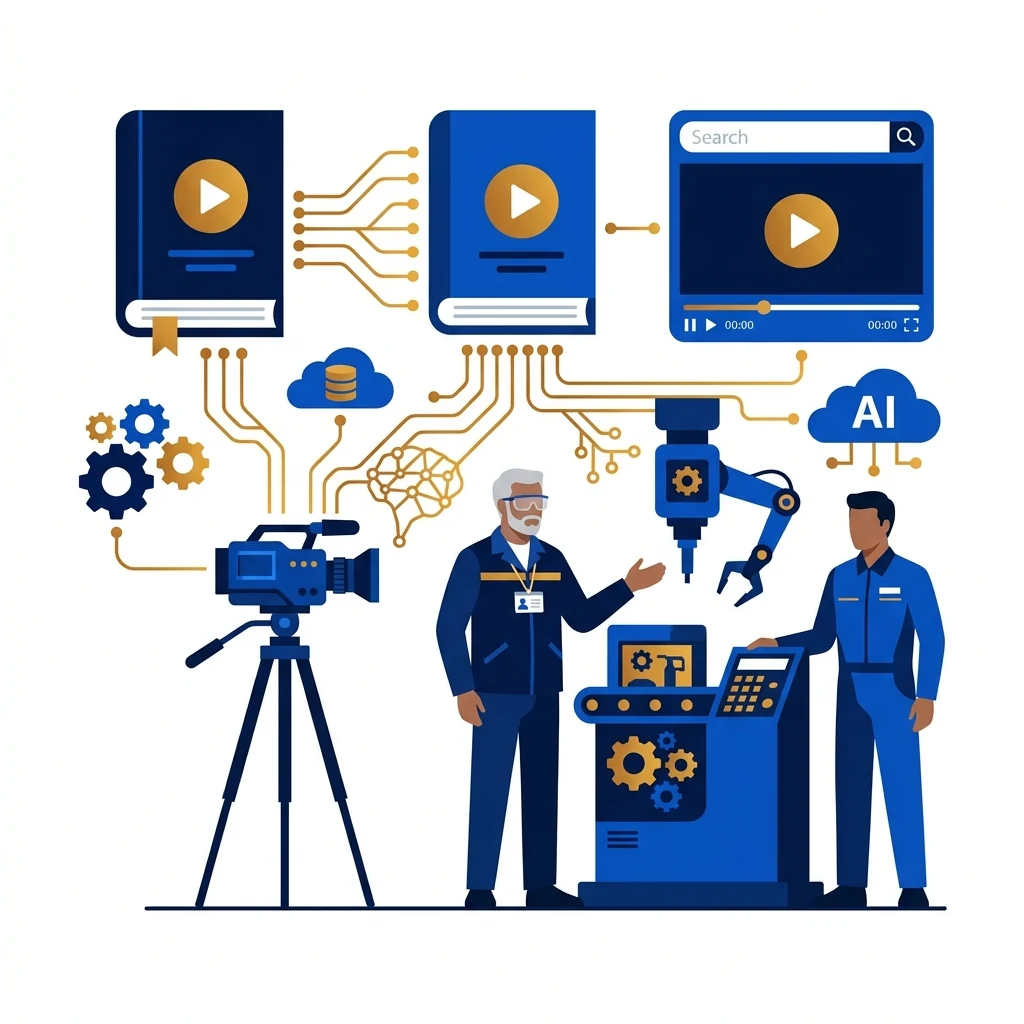
In nearly every manufacturing plant, there is a legendary figure: the veteran chief maintenance technician or senior automation engineer. He walks up to a vibrating stamping press, places his palm against the steel frame, listens for three seconds, and says with absolute precision: “The bearing on shaft three will seize by Friday, and that throttle valve needs a quarter-turn left, or the feed line will jam again.”
The crisis hits when that engineer announces their retirement date.
For plant managers and operations directors, this triggers immediate alarm. In industrial management, this expertise is known as tribal knowledge (or tacit knowledge). It has never been documented. Over 30 years, nobody had the time to write a 100-page manual, and asking a 64-year-old shop-floor master to sit in front of MS Word yields frustration. Younger technicians do not read dusty binders on the night shift, and an unresolved line breakdown can burn €50,000 in unplanned downtime in hours.
In the era of Industry 4.0 and AI, there is a vastly superior strategy: capturing expert tribal knowledge on the live factory floor with high-definition video and converting it into a searchable, AI-indexed knowledge base.
💡 Key Takeaways (TL;DR)
- Tacit tribal knowledge in manufacturing is essential to plant continuity, but vanishes the day senior technicians retire.
- Paper and PDF Standard Operating Procedures (SOPs) are effectively dead: nobody reads them during line stoppages, and they cannot capture sound, vibration, or tactile technique.
- Filming master technicians directly at the machine with a professional crew captures complex changeovers, sensory diagnostics, and rare fault recovery in just 2 shoot days.
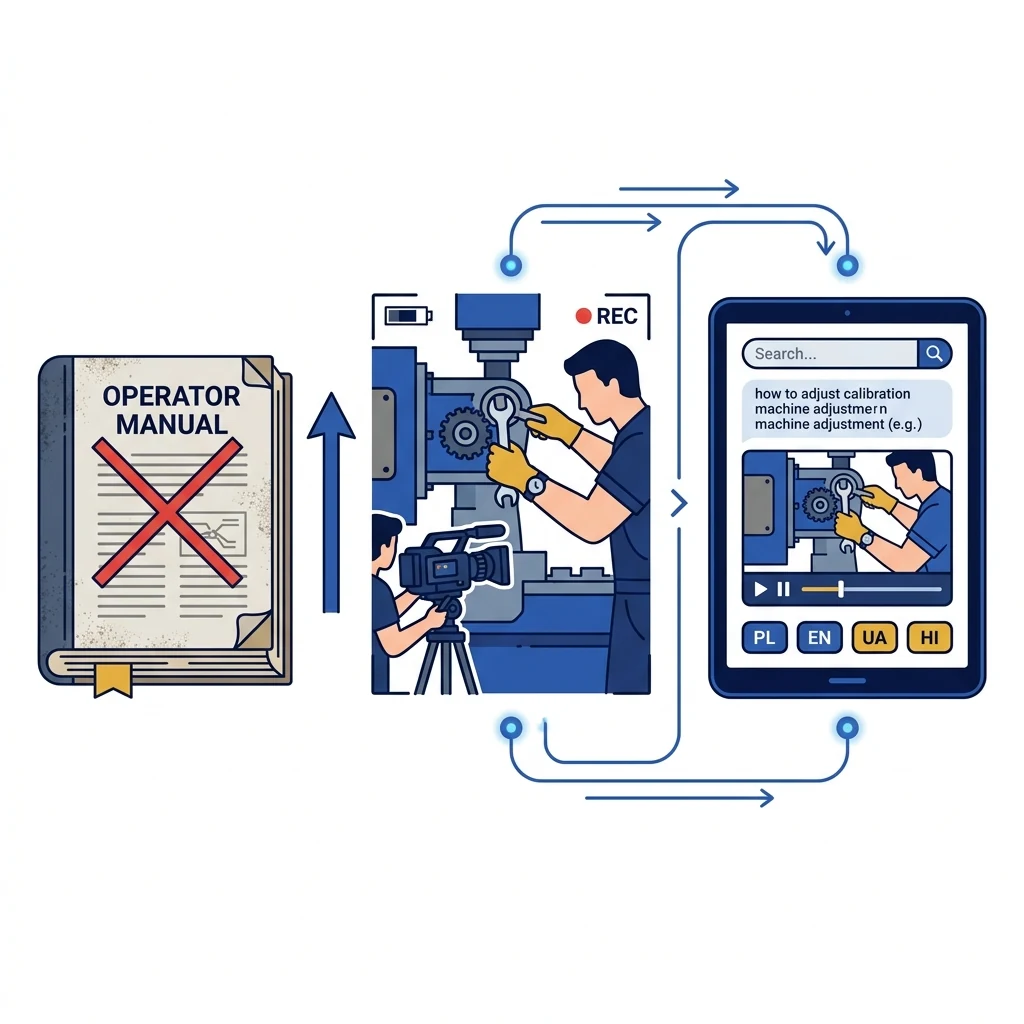
- An AI search engine indexes dialogue and visual cues: a technician on the line types 'oil leak press 3' and immediately gets a 40-second video clip with step-by-step guidance in their native language (EN, PL, UA, Hindi).
Why Legacy Documentation Fails on the Modern Factory Floor
Most industrial organizations attempt to safeguard knowledge using two antiquated methods:
- Creating 80-page SOP binders: Dense text and grainy monochrome photos. In reality, they sit locked in shift supervisors' cabinets. Worse, text cannot communicate the nuance of tool tension, the scent of overheating hydraulic fluid, or the distinct acoustic signature of a cavitating pump.
- One-on-one shadowing: A junior technician shadows the senior engineer for a month. Unfortunately, during that window, none of the 10 most critical, intermittent line faults may occur. The apprentice often picks up bad habits and forgets 80% of critical details within their first week flying solo.
We analyzed how video modernizes production standards in our handbook on video SOPs for manufacturing operations.
What and How to Film: The Knowledge Capture Protocol
A master technician is neither an actor nor an academic lecturer. If you put him in a sterile boardroom in front of a lens, he freezes and communicates very little.
At Sema Studio, our production team works directly in the expert's natural habitat using directed on-machine interviews:
1. Sensory Diagnostics (Sound, Vibration, Temperature)
The camera records what engineering schematics omit. We ask: “How do you anticipate a servo motor failure before the SCADA alert triggers?” The veteran points out: “Hear that metallic click every four seconds? The OEM manual says replace the entire drive assembly, but you just need to loosen this collar and blow out the jet with compressed air.”
2. Complex Line Changeovers (SMED Analysis)
We film step-by-step changeovers using macro framing to capture precise tool insertion angles and wearable POV cameras. Coupled with lean manufacturing analysis, this becomes invaluable training material — learn more in our breakdown of video SMED machine changeover analysis.
3. Rare Faults and Emergency Restart Routines
What happens when a high-speed line stops mid-cycle and the PLC throws error code E-402? The expert walks through the manual release sequence without risking a tool collision on a €150,000 die.
4. Ergonomics and Floor Safety Tricks
Experienced operators know the safest way to manipulate heavy assemblies without risking repetitive strain, and which blind spots optical safety curtains miss. We combine this with modern industrial safety induction video production.
The AI Layer: From Raw Footage to an Instant Knowledge Engine
Simply filming 30 hours of video doesn't solve the problem: no line operator has time to watch a 45-minute video when the line is down and every minute costs €500.
This is where AI technology converts video footage into immediate operational utility:
1. Semantic and Multimodal Search
All recordings are transcribed and parsed by large multimodal models. An operator on the floor doesn't need to know the OEM technical terminology. They simply type or speak into an industrial tablet: “bypass valve on hydraulic cooler 2” or “press punching off-center”. The AI evaluates spoken words, on-screen machine tags, and tool actions, directing the operator to the exact timestamp in the clip.
2. Automated Microlearning Breakdown
Long-form sessions are automatically segmented into 30- to 90-second standalone knowledge capsules featuring dynamic close-ups, graphic callouts (arrows, component highlights), and concise text checklists.
3. Dissolving Language Barriers: EN, PL, UA, Hindi, Tagalog
Modern manufacturing plants rely on international workforces. When a senior Polish or German engineer explains a nuance, enterprise AI models rapidly generate:
- Accurate technical subtitles in target languages with industry-specific terminology,
- Localized voice cloning that maintains the original speaker's timbre and cadence,
- Step-by-step summary bullet points for shift handovers.
Explore more on multicultural workforce training in our guide to safety video translation and multilingual localization.
Knowledge Transfer Comparison: Manuals vs Shadowing vs AI Video
| Feature | Paper Binders / PDF Manuals | 1-on-1 Shadowing (No Video) | AI-Searchable Video Knowledge Base | |---|---|---|---| | Time to Access Solution on Floor | 15–30 minutes (if found at all) | Dependent on mentor availability (hours) | 10–20 seconds (instant search on tablet) | | Workforce Engagement & Completion | Under 5% | 100% verbal, 20% retained | Over 90% (natural video engagement) | | Resilience to Staff Departure | Low (lacks undocumented tricks) | Zero (leaves with the employee) | 100% permanent intellectual property | | Multilingual Accessibility | Requires slow, costly agency translations | Severe language and accent barriers | Instant AI localization (EN/PL/UA/Hindi/etc.) | | Time Required from Senior Expert | Months of writing (high resistance) | Continuous interruption of daily duties | 2 days on-site film shoot |
Case Study: Automotive Tier-1 Stamping Plant (Central Europe)
The plant's chief die setter of 34 years was retiring in three months. Newly recruited technicians from Ukraine and Poland frequently called him during off-shifts whenever dies misaligned, creating an average of 4 hours of unplanned downtime weekly (estimated cost: €45,000/year).
Sema Studio conducted a 2-day cinema shoot on the production floor. Under professional directorial guidance, the retiring master demonstrated 14 critical fault recovery sequences and precise die-centering techniques. The material was packaged into 22 microlearning modules powered by AI semantic search and dual Ukrainian/Polish audio tracks.
Following the expert's departure, fault diagnosis time plunged by 68%. New technical hires reached independent proficiency in 3 weeks instead of the historical 4-month learning curve, transforming the library into a cornerstone of onboarding.
Cost of Knowledge Loss vs Video Investment
Consider the arithmetic:
- One hour of unplanned downtime on an automated production line averages €1,000 to €15,000+ in overhead, missed SLAs, and stranded labor.
- If a junior team struggles through 30 hours of avoidable machine bottlenecks over a year, the company forfeits €50,000 to €200,000.
- A comprehensive 2-day knowledge capture shoot, post-production refinement, and AI database deployment costs a fraction of that figure — an investment that routinely breaks even on the very first avoided line outage.
Review our transparent cost frameworks in our corporate video pricing guide.
Frequently Asked Questions (FAQ)
Frequently Asked Questions (FAQ)
What if our retiring engineer is camera-shy or refuses to be filmed?
This is very common. Our film directors do not treat technical experts like TV presenters. We never ask them to memorize scripts. We structure it as an informal on-machine dialogue, keeping camera angles focused on their hands, tools, and the machinery rather than their face if they prefer. Most veterans end up feeling proud that their life work is being recognized and preserved.
How are trade secrets and proprietary processes protected?
All footage and AI model pipelines operate under strict non-disclosure agreements (NDAs). We use enterprise-grade AI instances that do not transmit data to public models. The completed video base can be hosted entirely on your private company intranet or secure cloud.
How do shop floor operators access these videos in daily work?
Videos and the AI search portal can be accessed via ruggedized shop-floor tablets mounted at workstations, digital informational kiosks, or mobile devices via dynamic QR codes attached directly to machine chassis.
How far in advance of retirement should we start this project?
Filming can be scheduled whenever the expert is available, typically requiring 1 to 2 shoot days. Post-production, indexing, and AI setup take 2 to 3 weeks. Ideally, start 1 to 3 months before their departure to ensure comprehensive review.
Do video SOPs satisfy ISO 9001 and IATF 16949 audit requirements?
Yes. Video SOPs are increasingly championed by international quality auditors because they enforce standard operational consistency and provide digital timestamp logs of training completion.
Don't Let 30 Years of Plant Mastery Walk Out the Door
Before your top technician turns in their security badge, secure the operational lifeline of your manufacturing plant.
Contact Sema Studio. Review our industrial training capabilities in our training video production portfolio or connect directly through our Briefing Room. We will help you build an enduring digital knowledge base that protects your operations for years to come.